
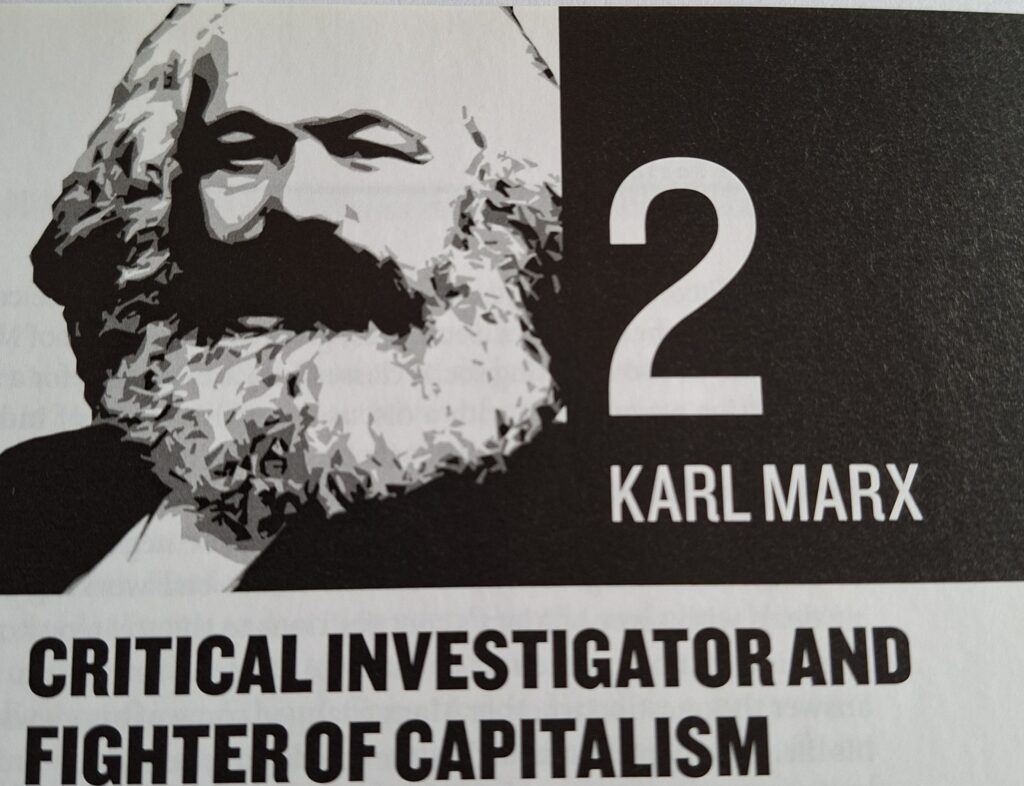
Karl Marx: theory and action against capitalism
In the night of 9 November 1989, after weeks of peaceful demonstrations, thousands of Eastern Germans walked towards gates of the much-hated Berlin wall. Rather surprisingly, East-German border guards did not take action. Thousands elated men and women, young and old flooded into West Berlin. On the other side of the wall, in West-Berlin, these East-Berliners were welcomed like long lost friends. Around midnight, as usual zapping to find something interesting on Dutch and international TV, l became a pleasantly surprised witness of this historic event. In the summer of 1961, when I was seventeen, newspapers daily presented shocking news about the construction an Iron Curtain between the Soviet Union, Poland, Hungary, Czech-Slovakia, the DDR and Western Europe. The USSR wanted to stop the steady trickle of people fleeing to the West. Soon the Iron Curtain became a hated symbol of the Cold War, especially after seeing photos of people that had been shot during their attempt to break through this Iron Curtain.
What would be the long-term effect of the fall of the Berlin Wall? Would the spectre of communism, once heralded by Karl Marx, now be ousted for good from Eastern Germany and other occupied countries? Would this evil ghost that had haunted Eastern and Central Europe for more than seventy years be busted forever? Does this mean that we can put aside all of Marx’s works and ideas? Should we forget all his concepts and theories that have occupied the minds of numerous social scientists, political activists and left-wing students and intellectuals for generations? Obviously, having written this lengthy chapter, I don’t think so.
Karl Marx (1818 – 1883) was a renowned scholar and political activist. He conducted critical and perceptive analyses of the mechanisms of capitalist economies. He predicted the immanent demise of capitalism and its replacement by communism. That was more than 150 years ago. Clearly, capitalism showed to be much stronger than he thought. And the communist societies that have emerged did not produce the equality and freedom that he had expected. His prophecies appeared to be based on wishful thinking, and nothing else. As a political activist, Marx failed to establish and lead a political movement that would end capitalism. Instead, some of his ideas formed the basis for revolutions that morphed governments into brutal regimes, helmed by shrewd administrators and dictators. The worst of them was Joseph Stalin. Though might be credited for transforming feudalistic Russia into a strong industrialized Soviet Union, and for decimating and pushing back Hitler’s armies all the way to Berlin, most historians hold this ruthless dictator responsible for the incarceration and deaths of tens of millions of Russians. Stalin did not stand alone. Other communist leaders copied his approach, claiming, like him, that the policy of the communist party always was right. Together they brought fear, misery, and injustice to more than a billion people. Their iron-clad rule led to the imprisonment and killing of millions of people in countries like the USSR, China, Cambodia, North Korea and North Vietnam. Yet, on the other side, ideas of Karl Marx have inspired many people in a positive way. They have urged democratic leaders to improve the social conditions for the poor. These non-communist leaders understood Marx’s alarming message about the plight of the underclass, but refrained from enticing violent revolutions and regimes of terror. In several countries, social democrats, social liberals, and progressive Christians successfully helped to increase the well being of the workers, the poor, the old, the sick, and the disabled.
2.1 Biography
Karl Marx was born on 5 May 1818. His place of birth was Trier, a historic German city on the banks of the Moselle. Karl became the eldest surviving child after two of his elder siblings died in early childhood. Political events had had a great influence on the life of the Marx family. First, the aftermath of the French Revolution liberated Jews from the ghettoes. Not much later Jews were allowed to become civil servants. However, in 1813, after Prussia annexed Trier, old restrictions were restored. His father, Hirschel Marx, converted to Lutheran Protestantism. Karl and his siblings were being baptized on 28 August 1824.[1] Without conversion it would have been made impossible for Hirschel Marx to remain a lawyer. Leonora Marx, Karl’s daughter, once wrote that her granddad had abandoned his religion freely and not for practical reasons. When Hirschel told that did not want to become a rabbi. He wanted to study law. This was quite a shock for his parents, as their ancestors had been Rabbi’s in Trier since 1723. Becoming a lawyer secured Hirschel Marx with a comfortable income. For him, the whole matter of conversion was hardly an issue. Already at a young age he had become a supporter of the ideas of the Enlightenment. When asked, he would say that he believed in Voltaire.
2.1.1 Childhood and student years
Karl’s mother, Henriëtte Presburg, was Dutch. She too descended from a dynasty of rabbis. Her father, Isaac Presburg, had settled in Nijmegen, a Dutch town near the German border. He had earned a small fortune as merchant and moneylender. So, Karl Marx was half German and half Dutch and raised in a well-to-do liberal family.[2] His aunt Sophie Pressburg married Lion Philips, a wealthy tobacco merchant. Two of their grandchildren would found a company that would become multinational Philips Electronics.[3]
Karl was privately educated by his father until he entered Trier High School. He did not excel at secondary school, though he was a good writer, always full of ideas. His neighbour, baronet von Westphalen, a high Prussian government official, noticed his curiosity. He stimulated Karl’s passion for classical literature and Renaissance art and ideas. His daughter, Jenny von Westphalen, fell deeply in love with Karl, though Karl was four years younger.
Aged 17, Karl went to Bonn to study law. He really enjoyed student leisure activities like drinking too much and partying too long. Soon, it became apparent that he could not manage financial affairs. So, his father ordered him to exchange the merry lifestyle of Bonn for the serious climate of Berlin.[4] From then on, study became his first priority. Even his leisure time got filled with intellectual activities such as learning foreign languages, translating classical texts, and writing poetry, novels, and plays. No wonder, he got overworked and had to take a rest cure.
During his studies, professor Eduard Gans treated Hegel as a progressive thinker. His main aim was changing society. Friedrich Carl von Savigny, the other philosophy professor, emphasized the conservative aspects of Hegel’s thought. Karl learned even more about Hegel when he became a member of the so-called Doctor’s Club – a bunch of radical, freethinking, young and marginal academics. In beer-cellars they liked to discuss the far from clear points of Hegelian doctrines with unclear heads for hours on end.
The schooling in two different strands of Hegel’s thought, and the critical discussions in the Doctor’s Club, ensured that some of Hegel’s ideas would always keep a hold on Marx.
Karl Marx was convinced that philosophical and social knowledge should be applied to achieve certain ends. He disputed the strict separation between scientists and politicians. He propagated a fusion of social analysis, social critique, and political action in order to construct a new world based on the outcomes of objective and critical analyses. However, he did not foresee that a strong commitment to create a better world could lure scientists and politicians into tunnel visions that would distort the truth and lead to practices that would harm society.
Marx was the youngest member of the Doctor’s Club. Nonetheless, his ideas he had a great influence on other members. Karl lost his motivation for studying law and turned to philosophy. The public exchange of the wild and revolutionary ideas of the Doctor’s Club had been drawing a lot of attention. All members did become politically suspect, which ruined their academic careers.
Marx’s PhD thesis of 1841 was a study of the work of Epicurus. He admired this destroyer of Greek myths and divinities and praised Epicurus for his bold attempt to free people of the fear of Gods. Such fears are alien to the essence of man. Marx agreed that: “Not he is heathen, who rejects the Gods of the masses, but he who attributes the images of the masses to the gods.” Images of gods have no right to exist in the Land of Reason.[5]
2.2.2 Exile
As fanatic critic of society, Marx had lost all chances of making an academic career. He found a job as a journalist for the Rheinische Zeitung (Rhineland Paper). Within six months, he became the editor-in-chief. Under his leadership, the paper quickly headed for a head-on collision with the conservative government, which could not stomach the anti-Christian and anti-Prussian articles.
This short stint in journalism opened his eyes to the pains of poverty, but also fostered a hate for censorship. Marx felt a growing urge to write frankly about the plight of the poor and the misery of their social conditions. He noticed a sudden rise in the number of lawsuits regarding theft of wood. The reason was a clash between common law, which allowed people to collect fallen branches for their stoves, and new legislation that gave foresters the right to stop this. Marx sided with the men and women who were too poor to buy firewood. Throughout his life, he felt strongly committed to the plight of the paupers. Whenever he raged against the miserable conditions of workers, he always did this with a clear image of what he had witnessed: undernourished children and humiliated and worn-out men and women, living in overcrowded houses lacking all comfort.[6]
With an academic career that never got started and an aborted career as radical journalist, there was no future for Marx in Germany. In 1843, he went to France, hoping to find steady employment there. He found some work as a freelance journalist. In Paris, he met all kinds of radical thinkers, artists, and activists. He held lengthy discussions with communists: anarchists, utopists, and Christian socialists. Many of them were immigrants. He and Jenny became friends with poet Heinrich Heine. Their friendship was never tested by quarrels. This was quite exceptional because Marx had a confrontational nature and did not agree with Heine, who was not a communist. Somehow, Marx found that great artists had to be treated differently than philosophers, with whom he would disagree sooner or later. According to family legend, once Heine saved the life of baby Jenny. He quickly put her in a bath when she had an attack of cramps. Karl and Jenny, who were rather incompetent parents, had no idea what to do.[7] In Paris, Marx also met the Russian anarchist Mikhail Bakunin. These meetings sharpened Marx’s radical thinking and opened his mind to new perspectives. He turned into a zealous communist. This break became all too manifest in his articles for a radical German paper printed in Paris. Again, he aroused the anger of German rulers. The latter pressured the French government to oust him. So, in 1845, he moved to Brussels after promising the Belgian government that he would not take part in political activities.
2.1.3 A lifelong bond with Friedrich Engels
Marx met Friedrich Engels in Paris. Promptly, they became friends. This friendship lasted until Marx’s death. Engels had worked in Manchester for a few years. This inspired him to write “The condition of the Working-Class in England.” In Manchester, center of the Industrial Revolution in England, cut-throat competition and technological innovation created inhumane working conditions. Engels thought that this extreme exploitation would drive workers to acts of rebellion against capitalists.
Engels had a great impact on Marx’s development. They shared similar ideas and political motives. Moreover, Marx needed Engels’ help and stimulation for his opus magnum: Das Kapital (Capital). They formed a perfect match, intellectually and politically, but they were strikingly differed in character and lifestyle. Engels was a gentleman who enjoyed life, leisure, and good food. Marx was serious, frugal, and badly dressed. Engels was the son of a patriarchal textile-mill owner, from Wuppertal. He grew up during the onset of the Industrial Revolution in Germany and became a sort of ‘double man’: by day, a capitalist, helping to run his father’s firm in Manchester, and by night, so to speak, a revolutionary communist.
Friedrich Engels had declared himself a communist long before Marx did. In 1844, in Description of Recently Founded Communist Colonies Still in Existence, Engels declared that communism simply meant ‘community of goods’. He tried to dispel the objection that this was a utopian aspiration by pointing to its realization in three American communities: the Harmonists, the Shakers, and the Rappists. In these sects money had been abandoned. There was free choice of work; nonetheless, goods were being produced in abundance.[8] To him, it was obvious that we cannot live without support of our fellow men. Friedrich Engels was an atheist. He wanted to reorganize society on more rational principles by setting up a central planning authority that would organize the production of necessary goods. Also, governments should introduce basic education for all children. During the transition to communism governments must organize a system of financial assistance for the poor, and introduce a progressive tax on capital.
Marx worked like a typical German scholar: conscientious, thorough, and precise. Doing so, his work progressed slowly. Besides, political activism often lured him away from his desk. Engels often had to finish off his texts. During his years in Paris and Brussels, Marx studied economics. This sharpened his political views and distanced him from the young Hegelians, which became crystal clear when he published his book, sarcastically titled “The Holy Family”. Herein, Marx attacked the ideas of Bruno Bauer and his brothers. He found that these left-Hegelians were squandering their time and energy on pointless philosophizing, completely blind to the harsh reality of poverty and the painful lack of social justice.[9] Critics had attacked Hegel’s work before, but never had attacked the core of his philosophy. And precisely this was the objective of Marx and Engels.
Karl Marx was full of energy. He suffered from overdoses of willpower and self-conviction. All too often, this led to the expulsion of members from his committees or associations that dared to deviate from His Master’s Voice. This happened to Pierre-Joseph Proudhon, who lectured Marx on his vindictiveness and dogmatism:
“Let us have decent and sincere polemics. Let us give the world an example of learned and farsighted tolerance. But simply because we are at the head of the movement, let us not make ourselves the leaders of new intolerance. … Let us never regard a question as exhausted. … Under these conditions I will gladly enter into your association. Otherwise – no!”[10]
Proudhon preferred gradual and orderly change. He rejected revolutions, and even denounced strikes. In The poverty of philosophy a merciless Marx criticized the talented, but autodidactic Proudhon. He thrashed his utopian socialism, his limited understanding of economics and Hegel, and pointed to several contradictions in his work.
In Paris and Brussels, Engels fed his friend with valuable information of the words and deeds of industrial entrepreneurs and other capitalists. Marx’s thinking shifted from philosophy to political economy. He realized that he must delve deeper in the study of economics. He read the works of Adam Smith, David Ricardo, and James Mill, critically analyzing their ideas.[11]
2.1.4 Isolated in England
In London, The German Association for the Education of Workers asked them to write an easily readable pamphlet about their views. The Communist Manifesto began with the famous phrase: “The history of all hitherto existing society is the history of class struggle”. In one stroke this sentence revealed the core of Marx’s social analysis. In 1848, a few weeks after the manifesto was published, and before it was widely read, revolution broke out in Paris and Germany. Marx decided to return to the continent. He visited Paris first; then traveled to Germany to become editor of another radical paper.[12] The 1848 revolution was short-lived. Nevertheless, it had shocked the ruling classes of Europe. They joined forces and responded in a reactionary way.
Marx failed to get fully accepted by the English labour movement. Disappointedly, he withdrew himself in the confinements of his home or the library of the British Museum. Meanwhile, he remained hopeful of a rekindling of revolutionary fires in Germany and France.
Without a steady job, Marx often was penniless. From time to time, Engels gave him some money, urgently needed for paying the rent and the bills of the bakery. Sometimes, Engels also brought a few bottles of good wine to cheer up his friend. Often, Engels helped Marx by writing his articles for the New York Daily Tribune, for which Marx was a correspondent. Engels had more expertise in certain economic topics and penned articles more quickly. Meanwhile, Marx was immersed in the writing of Das Kapital.
In London, Marx tried to establish an international communist movement. As leader, he molded the political program to his own will. However, this international organization was plagued with internal struggles. Dogmatic conflicts dominated the first four international congresses, because Marx stuck to his ideas, as published in The Communist Manifesto and Das Kapital. He vigorously defended his vision that the way to a new society would involve many conflicts, being convinced that a well-organized working class would win the war against capitalists. True socialism could only be reached through a necessary transition period in which the proletariat would seize power. It could not happen in any other way.
For several years, Marx believed that he had formulated the right theory of capitalism. He took pride in himself for heading an international organization that would end the burden of the working class and all the misery produced by the capitalist system.[13] In 1872, during the last congress in The Hague, the first one he attended personally, Marx gained supremacy. He succeeded in expelling anarchist Bakunin and his followers. Marx rejected their idea that not only the state, but also that all hierarchical organizations must be demolished. Alas, it was a Pyrrhic victory that heralded the demise of his international movement. Mutual rivalry and embitterment had risen to such a mountainous extent that further cooperation became impossible between Southern anarchistic factions and the labour unions and labour parties of Northern Europe.[14] In a meeting held in Amsterdam, right after the congress, Marx told a hostile audience,
“We are aware of the importance that must be accorded to the institutions, customs, and traditions of different countries and we do not deny that there are countries like America, England, (and if I knew your institutions better, maybe I would add Holland) where the workers can achieve their aims by peaceful means. However true that may be, we ought also to recognize that, in most of the countries on the Continent, it is force that must be the lever of our revolutions …”[15]
Clearly, Marx had learned valuable lessons from failed revolutions. Yet, he remained a revolutionary thinker until his dying day.
After the breakdown of his international organization, Marx retreated from the hustle and bustle of the world and immersed himself into reading and writing. He was plagued by various illnesses, boils, and ulcers. Poverty drove Karl Marx to revisit his relatives in Germany and Holland, to beg them for financial help. Sometimes, his wife Jenny was sent on a begging tour. During one of her absences, Marx impregnated their housekeeper Helene Demuth. His son, Henry Frederick Demuth, was born in June 1851. However, Marx denied paternity. Though this sordid affair was a great blow to Jenny, she helped to save his reputation. The boy was adopted by another family. Rather surprisingly, Helen remained housekeeper of the family.
Jenny and Karl had seven children. Only Eleanor and Laura outlived their father. Eleanor never married. She lived together with the notoriously unreliable Edward Aveling. When she discovered that he secretly had married a young actress, he proposed a suicide pact to solve the crisis. However, after she had swallowed the lethal dose of prussic acid, Edward did not follow suit. Callously he left the house to join his young wife. The Marx family was plagued with severe illnesses and the death of two grandchildren. In 1878, Jenny, his dearly beloved wife, was diagnosed with cancer. She died on the 2nd of December 1881. One year later, also daughter Jenny died. Karl Marx died on the 17th of March 1883. There were only eleven mourners at his funeral at Highgate cemetery. One of them was Friedrich Engels. He predicted that Marx’s name and work would last through the ages.
- Hegel and Marx: Thesis and antithesis
When student Marx arrived in Berlin in 1836 Georg Friedrich Hegel had been dead for five years, but his spirit was still alive. Hegel’s thinking had an important effect on Marx’s view on history. Therefore we should pay some rudimentary attention to his ideas. However, his work is considered to be ‘awesomely complex’ and ‘monstrously ambiguous.’ I will only sketch some elements.[16]
2.2.1 World history and the realization of “The Absolute Spirit”
Hegel was convinced that the mental or spiritual world was the primary reality, from which the material world was deduced. In his view, self-consciousness and standing up for your own rights and personal freedom can only be reached through a power that he called The Spirit. To Hegel, this abstract phenomenon lives in the consciousness of individual humans. The Spirit is incorporated in objective form in cultural products, such as the legal system. In Hegel’s thinking, there also exists a higher spiritual level: “The Absolute Spirit.” This expresses itself in fine art, religion, and philosophy.[17] Apparently Hegel sees art, religion, and philosophy as a kind of Divine forms of culture, much higher than man-made laws, beliefs or common sense thinking. To Hegel, the “Absolute Spirit” coincides with The Whole, in all its complexity and infinite character. It is completely autonomous. Only a spiritual reality can be unlimited and completely autonomous.
I prefer to descend quite a bit from this high level of abstract thinking. For understanding Marx here, it might suffice to point to Hegel’s view that The Spirit within us has not yet unfolded all its potential. This can only happen when it has attained full insight into itself, when it has become conscious of its complete self.[18] So for Hegel the history of mankind is a learning process. Somewhere in the future, human freedom will be fully realized, in the ultimate insight that nature and society are externalizations of the essence of “The Spirit.”[19] That is the goal of history. When human freedom will be realized, we will witness “the end of history.”[20]
“It is the essence of The Spirit to learn to know itself, to see itself and to realize itself as it is. That will be accomplished in the history of the world. Thus, the ultimate goal of world history is that man grasps what he really is… and that he … makes himself into that what he is.”[21]
From this quotation we may conclude that “The Spirit” as theorized by Hegel contains a telic principle that has to develop and reveal itself, just like seeds contain a specific program that will produce blossoming flowers and trees full of fruit. Nowadays it is generally assumed that this kernel can be found in the genetic code, in the dna-structure. Hegel overlooked or ignored that a seed of plant can only grow and develop in an optimal way under favorable physical conditions. This means that the unrestrained development of one seed may harm the development of many others. Think of big trees. To develop fully, they can’t help overshadowing other seedlings and usurp so much water and fertile material that many other trees, flowers and even grass will wilt away.
Hegel favored a developmental model of unconditional progress. For him, the advancement of world history is inevitable. It will continue its journey to its true and final destination. Every period is determined by its predecessor and determines its successor. The power of thinking pushes history ahead and elevates man and society to a higher level. Marx supported this view but replaced the intellectual motor by a materialistic one. Doing so, he upended Hegel’s philosophy, arguing that he put historical theory back in its proper position. In Marx’s utopian view, the end of history coincides with the fulfillment of human emancipation. It is an eschatological theory, a doctrine of the inevitable salvation from the oppressive hell of capitalism. For Marx, this process leads to a political situation in which all people can realize their true selves. For Marx this is true communism.
2.2.2 Hegelian dialectics
Hegel’s main theme is the discrepancy or opposition between the “Absolute Spirit” and the world as it is. As “The Spirit” materializes or externalizes itself, it becomes alienated from itself. The worldly object is ‘alien’ to the spiritual subject. Thus, a dualism emerges between “The Spirit” and its materialized form or ‘negation,’ that is, its part that is objectified in the material world. This opposition or tension can be mitigated or removed when it leads to a kind of ‘purified’ return to the original situation: the alienated element comes back to and gets digested by the wholeness of The Spirit. So now, something has been added: the consciousness of what has emerged in material form, though not yet in a perfect form. In the next step of this developmental process, the spiritual unity between subject and object will be improved and lifted to a higher plane.[22]
As long as a person does not do, say, or think anything, he only exists as a biological entity. He exists only for himself. As soon as humans do, say, or think something, they produce something that exists outside them. It can even be strange for a person to realize that he has said or done the very thing he just said or did. But the subject and that what he has externalized will be united as soon as he acknowledges that he really did, said, or thought it. Through this process, people become wiser and sadder perhaps. The subject has become more mature and more self-conscious. In that sense, humans attain a higher level, thanks to the objective act, the alienation that it aroused, and the final appropriation of the act as a personal act.[23] This is dialectics in process.
The concept of such a dialectical movement means far more than an interaction between a thesis and its negation or antithesis. The full movement has to lead to a synthesis that adds something new. The synthesis should bring theory and practice to a higher level. At first, there is an idea, a theory or political movement based on a specific thesis or doctrine. Hegel assumes that such a thesis will bring forth its antithesis; for the seeds of the antithesis or countermovement are already present in the thesis, since it is imperfect. It might be one-sided or has other weak spots. The antithesis or countermovement is directed against these defects and weaknesses. This arouses a real conflict. The original meaning of dialectic is dispute, a conflict about arguments. It is assumed that this argumentative struggle will result in a compromise in which the oppositional stances fade away, a compromise that eradicates the weaknesses and joins the positive elements of the thesis and the antithesis. They are elevated to a higher plane.[24]
synthesis-1 (:= thesis-2)
thesis-1
antithesis-1 |
Figure 2.1
Perhaps the explanation of dialectics presented here is already sufficient. On the other hand, the explanation of this concept cannot be clear enough because many questionable interpretations of this concept are used in books and articles. Hegel, and especially Engels, may be blamed for this, because they equated dialectal development with the genetically programmed advancement or growth (entelechy) that we see in biological organisms; for instance the absurd idea that the seed is the negation of the flower. Karl Popper warned that we should be very careful in using the term dialectic. Perhaps, it might be best not to use it at all.[25] He acknowledged that the dialectical triad could sometimes be used as a description of processes in philosophy in which a certain thesis, because it has some weak spots, entices opposition. Philosophical discussion may lead to some sort of solution, which, in a sense, goes beyond both thesis and antithesis by merging the good parts of both.[26] There may have been a few periods in history that could be described as a dialectical series of thesis, antithesis and some kind of synthesis. But by far most historical sequences do not show such a dialectical pattern. Many historical periods evoked negative reactions, violent revolutions and counter-revolutions, but they seldom ended in a long period of peaceful co-existence.
2.2.3 To be versus what ought to be
Hegel viewed history as a process in which The Absolute Spirit unfolds itself and humans become more conscious of their own nature. For him, philosophy is tasked to support this process. Each new phase in history reveals that the previous phase was not perfect. It was less rational than it appeared to be during its glory days. Philosophy can only clarify with hindsight why a former phase was not perfect and why it had to be replaced by a new era and new worldview. This means that dialectical philosophy is a method for interpreting the past; it is not a useful method for running ahead of historical developments. However, in other instances, Hegel contended that successive philosophical systems are advancing the development of the truth. They have a critical function, as long as history has not reached its final goal, that is, as long as society has not achieved its ultimate condition of reasonability. Until that moment, critique has to break through societal complacency and inertia, and open the door for new social and cultural possibilities.
An important strand of Hegel’s philosophy is anti-utopian. For utopian thinkers ‘what ought to be’ should prevail over ‘what is’. Thus, he appears to sanction the existing social order. We must be careful here. His philosophy can also be interpreted as a demand to make reality reasonable. But his often-bandied aphorism, “That what is real is reasonable” strongly hints at a conservative than a progressive mindset. In the final stages of his life, Hegel fully accepted the actual situation of Prussia. For him, this manifested the realization of the Absolute Spirit. He was convinced that individual freedom had come to terms with the general interest. The end of history had arrived, and philosophy had, thanks to his own contributions, fulfilled its most important task. The only thing to be done for social philosophers was to protect western society from a backlash and to spread the perfectly reasonable situation of Prussia among all the peoples of the world.[27] In no way Marx could reconcile this view with the squalor and misery he observed everyday. Clearly, the world was far from perfect. So, there still was a great need for a truly critical social philosophy. For Hegel, the wrongs of Prussian society were only minor hiccups. They had no significant effect on reality. For Marx, they were clear signs that society was heading for a revolution.
2.2.4 The dialectical method
Is there such a thing as a dialectical method? Marx mentioned this several times but he never explicated what he meant by this. However some people seem to be pretty sure what he meant. IN 1872, a Russian critic presented such a clear a description of this method that Marx quoted him in the preface to the second print of Capital, though without mentioning his name. This anonymous analyst stated that Marx not merely wishes to know the laws that control social relations in a specific historic context, but that he, above all, wants to come to grips with the sociological law that explains the process of change of social structures and relations, in other words, the theory that describes the transformation from one situation into the other.
“As soon as he has discovered this scientific law, he will investigate its social consequences into the smallest detail.
… It completely suffices that he can proof that the historical necessity of the present ordering necessitates the future ordering, in which the first is compelled to transform itself, whether the social agents … are conscious of this process or not. Marx sees this historical movement as a natural process, determined by social laws that are independent from the will, the consciousness and the intentions of individuals, but, rather determine the will, consciousness and intentions of the people involved. … But, one is inclined to respond, the general laws of the economic system remain the same, whether they are applied to the present or the past, do they? Marx denies precisely this. In his view such abstract laws do not exist within social science … As soon as life has gone through a certain period of development, has passed from one stage to the next, it will be controlled by other laws.”[28]
This appears to be a very good summary of Marx’s views on historical materialism. It is historic, because each epoch has its own social laws. And it is materialistic, because each new technology determines the necessary changes in society. A new phase in technology, a new way of manufacturing products leading to a new division of labour renders new living conditions, thus renewing society as a whole. All this generates a new way of viewing at life in general, at people and their social relations in particular. So there is nothing obscure or oblique in the aims or the methods of the dialectical method.
Marx was a real empirical researcher. He was always looking for reliable data. He found them not only in official reports, but also by close observation of factories and the houses of poor labourers.
2.3 From dialectic idealism to historical materialism
In 1841, Ludwig Feuerbach (1804 – 1872) presented a ferocious critique of Hegel’s abstract ‘theological’ ideas. He argued that the basis for any study of mankind should be the ‘real’ human being, living in a real, material world. Feuerbach stated that the Absolute Spirit or Divine Power emerges from real life and not the other way around. The divine is a human illusion. For Feuerbach the gods are simply a projection of typical human characteristics projected on some impersonal forces, placed as a deity outside the world and above the self. Thus humans belittle themselves and, in one sweep, also alienate themselves from one’s own true self. They endow these self-created gods or Divine Spirits with special features such as sacredness, purity, and perfection, whereas they depict themselves as sinful, powerless, and imperfect.[29] Feuerbach urged philosophers to stop thinking about the Absolute Spirit or Divinities and to focus on human beings that are, by nature egocentric, continuously looking for personal happiness. Study the here and now; observe and examine mankind as a natural being. Stop using speculative concepts, but direct your attention solely on that which really exists. Only there the truth can be found. The senses can only register truth and reality. They are identical. Man does not exist from abstract, metaphysical and theological realities, but from concrete, tangible, visible things.
2.3.1 The dialectic triad revisited
Feuerbach rejected philosophical idealists such as Hegel. They detach thinking from being. The real subject matter of philosophy is man as a physically existing and thinking being.[30] Feuerbach built a bridge that connected idealism with materialism. At first, Engels and Marx were pleased with this move, but after a while, they realized that Feuerbach did not go far enough. In their view, he was still too much involved in a religious way of thinking. A fully materialistic approach is more adequate. To them, the problems of modern society are based on material causes, such as the structure of capitalism with its unequal distribution of money and power. The materialistic approach of Marx and Engels stands diametrically opposed to Hegel’s view that the material is only a reflection or an externalisation of what is in our minds.[31] For Marx and Engels, consciousness always equals being conscious of concrete things and persons. Feuerbach opened the door to that view. He passed the barrier from the ‘Absolute Idea’ to human thought. Thus, he realized the passage from idealistic philosophy to anthropology. Marx and Engels went one step further. They moved from anthropology and humanistic philosophy to social philosophy and sociology, toward the being and consciousness of real humans in their social-historical context.
Furthermore, Marx steered sociology towards a conflict approach. He stressed the eternal war between interest groups, the incessant struggle between dominating and dominated classes, thus ending a purely evaluative philosophy. He opted for a critical analysis of the real world. He wanted to unearth the mechanisms that produced and reproduced inequality, injustice and oppression. He wanted more than theoretical abstractions. Above all, he wanted praxis, a valid intellectual reflection that is highly useful for political action. He wanted ideas that could revolutionize social relations. Like most philosophers, Feuerbach did not consider praxis, meaning the practical activity directed at social change. This led to the famous eleventh thesis against Feuerbach:
“The philosophers have only interpreted the world in different ways; the aim is to change it.”[32]
2.3.2 Basic materialism
The term ‘materialism’ is likely to suggest the doctrine that nothing exists except matter. Marx did not hold this view. For example, in his theories, much hinges on his analysis of marketable goods, in other words, objects of exchange or commodities. Commodities are the basic form of wealth in capitalism. But Marx put much emphasis on the fact that commodities also have non-material properties that are vitally important for understanding their nature. They have exchange-value, and this value can extinguish all material characteristics. The market value of a commodity can vary daily or even hourly. Often enough there is no longer a direct relation between material costs and labour costs of commodities. Nonetheless, materialism is the basis of his philosophy.[33] Matter is the basis of our physical and social existence. Matter is the sensuous reality, that which is visible, hearable, and tangible. It exists in our consciousness, but also out in the world. It can be observed using scientific methods. The spiritual exists only in our minds. Man exists and thinks; there is being and also a consciousness of being.
The form of materialism strongly associated with Marx is historical materialism. He did not use that expression, but frequently referred to the material basis of his scientific method.[34] The existence of real human beings constitutes human history. The first fact to be established, therefore, is the physical constitution of humans and their relation to nature. Whatever else human beings may be, they are first and foremost physical organisms. They have to eat and drink. They need a habitat, clothing, and many other things. Hence, the first historical act is the production of the means to satisfy these needs, the production of material life itself. As long as people have to engage fully in satisfying basic material needs, there is no time and energy left for intellectual and political activities or aesthetic pleasures.
The crucial distinction between humans and animals is not that humans think, but that they produce. According to Marx, people begin to distinguish themselves from animals as soon as they begin to produce their means of subsistence. Marx was foremost interested in a form of labour that is exclusively reserved for humans as opposed to more instinctive forms of production reserved for animals. You could almost say that Marx did not like it when nature’s offerings are plentiful and man does not have to work hard and use clever survival tactics. Only then nature keeps man in hand, like children in leading strings.[35] Humans distinguish themselves from animals as soon as they invent products and methods of production. By ingeniously producing their means of subsistence, they indirectly produce their whole way of life. How they do this depends on the available means of production, which they have to maintain, to reproduce, and to upgrade in order to remain successful producers.[36]
The mode of production is the basis for society. Hence the form of production must be the starting point for any social analysis. The level of technology has a great impact on the structure of society; it determines the division of labour. It shapes the history of mankind. In premodern societies, there was hardly any division of labour. All men went fishing or hunting using self-made tools, they all chopped wood and built their own simple huts or houses. The women gathered fruit, nuts and plants and cooked meals for their families. They made and mended their own clothes, if any. Real specialization emerged later in the history of mankind. Then men became fishers or farmers, bakers or builders, tailors or tradesmen, soldiers or priests, inventors or copycats. Each new form of production and level of specialization produced its own form of property relations. First, there was the small tribe with its collective tribal property. When tribes merged and formed larger societies, the idea emerged that all major property belonged to the entire community. In feudal times, this was superseded by a system of landowners who possessed many acres of land with serf labour chained to it. And finally, capitalistic relations put the ownership of land, machines, and buildings in the hands of a few. As the scale of economic activities increased, tools and machines became too expensive for the individual craftsman or skilled worker. Only the owner of large shops, factories, ships, and office buildings could afford and possess these expensive (private) properties often financed by shareholders or state subsidies.
2.3.3 Basis, superstructure and false consciousness
The whole system of forces of production, technology and the organization of producing goods shapes the economic structure. But more than that, it also shapes the political and judicial superstructure. The concept superstructure is a very broad, general, and loosely defined. To Marx and Engels it comprises almost the whole of social life, bar the real economic basis. The production of the means of subsistence is conceived of as the basis of all social relations. Again, this is only an analytical construction. In real life, the economy is not separated from the rest of society. We should also keep in mind that superstructure is not another word for culture, collective conscience, or the whole set of ideas that exist within society. It is more. Culture is only a part of it. It also embodies the political and judicial institutions, organizations, ideas, and regulations. It also covers social elements that have a real ‘material’ existence. In fact, the superstructure covers two meanings. There is the political-judicial element, including the whole political and legal machinery, and there is the cultural part, including the prevailing ideology.
Marx and Engels did not invent the term ideology, but they helped to make it a core Marxist concept. Whenever they used this term, it was in a derogatory sense, almost always in connection with false consciousness.[37] This could give the wrong impression that ideology and false consciousness are synonyms. Ideology is much broader than false consciousness. Individuals and social classes can suffer from false consciousness with respect to their actual social position and their objective social condition and this can partly be affected by the prevailing ideology. For individuals, ideology functions as consciousness of their shared social condition, social interests and objectives. Consequently, this ideology determines their social actions. False consciousness occurs when individuals or groups have a wrong view of their actual social position, in particular their position within the economic basis. As long as workers do not see themselves as members of an oppressed and exploited class they will not adopt the ideology that a class struggle is needed to improve their situation.[38] On the basis of the abovementioned, it is possible to sketch a four-layered model of society that reflects Marx’s ideas about the structure of society.
Scheme 2.2 Basis and superstructure
basis | 1 the level of production forces or state of technology; 2 the economic relations determined by the production forces. |
superstructure | 3 the legal-political order that emerges from this economic foundation; 4 the ideology that supports the economic order and the connecting legal-political system. |
In the course of time, sliding walls are placed between the political and economic relations obscuring the coherence between both levels. However, it remains a fundamental fact that political relations are somehow an adequate expression of the economic interests. Admittedly, as any social institution, the state is inclined to become rather independent. A thorough analysis will show that this dependence still exists.[39] The progressive unfolding of the economy has brought forth groups with conflicting interests. So, there is need for judicial and political regulation. This is necessary for the birth and growth of the state. The constitutional state has to mend what went wrong socially. In the jargon of Marxists, this is described as a situation in which society has enmeshed itself in an irreconcilable contradiction.[40] Whenever such conflicts emerge, the state will side with the ruling class. Once more, this underscores the Marxist view that the legal-political superstructure is closely connected with the economic relations. The state does not solve the contradiction but lets it fester. It suppresses the working class and maintains law and order in the interest of the dominant class.
How does the state run its affairs in these matters? It does not shun the use of violence. But the principal method is the creation of a certain image that legitimates its actions. Firstly, there is the narrative that the state has so much power that any resistance is useless. Coupled to this image is the Hegelian idea that the state in its present form is necessary and reasonable. There must be order; there simply is no alternative. Thus, the state succeeds in persuading the oppressed classes that the existing state of affairs is sensible one and wholly legitimate. On the basis of personal experience and thorough study of the hard facts of life, Marx argued that social conditions, in particular economic power relations, determine the form and functions of the state. Instead of criticizing the state, it is better to criticize society. The state is simply an instrument of power for the ruling class. In the nineteenth century, this was accentuated by the fact that workers (and women) had no right to vote. Only people who paid a certain amount of income tax were entitled to vote and to be elected. Therefore, the poor had no representation in any parliament or government. Hence, Marx believed that the state would not play a role in breaking down the relations of production; these revolutionary forces would have to come from society itself.
The economic foundation of society influences the ideological views of the government. This is particularly true for the legitimacy of the methods used for maintaining order, or for the way in which the state attempts to solve conflicts. The state authority also supports other ideological opinions, such as the justification for a highly differentiated system of positions and salaries. In Marx’s view, all the prevailing opinions regarding the right organization of society can be deduced from their functionality for the economic base. It has to be admitted, however, that well-established ideological representations can become partially autonomous forces. Their dependence on the base is indirect. Political views are faced with alternative representations, encouraging autonomous reflection upon the present state of affairs. Besides, society is not static but dynamic. New developments lead to new conflicts over the organization or need for reorganization of society. This generates new ideas and new solutions. We can witness a strong interaction between the economic base and the ideological superstructure during periods of significant social transformations. This shows that the basis only partially determines what goes on in the superstructure. Nevertheless, it also must be stressed that Marx and Engels always were inclined to fall back on the statement that, in the final instance, the economic foundation determines the prevailing set of ideological representations.
- Class struggle as the prime mover of social progress
The work of Marx is closely connected with the mainstream of European philosophy. This is in particular true of his great trust in progress. In the 18th century, Leibniz was one of the first great thinkers to draw attention to the idea that every organic creature goes through a series of stages. It was his assertion that nature does not jump, but develops gradually; that nature is burdened by its past and is pregnant of its future. The progress of science made Leibniz optimistic. He truly believed that mankind was heading for an ever-increasing measure of happiness.
- The origin of the idea of social progress
Most Enlightenment philosophers believed that progress would be realized in a gradual and orderly fashion. But some thinkers cherished a completely different idea. They followed Ancient Greek philosophers such as Plato, who argued that progress was based on disputes and conflicts. Another philosopher, Herakleitos, argued: “Struggle is the father of all things.” Moreover, everything tends to change into its opposite. Immanuel Kant, the great philosopher of the Enlightenment, also thought that conflict was the driving force behind social progress. Why? Humans must live in groups but they are also egocentric and this produces conflict. Kant was convinced that this would generate progress, simply because people are compelled to solve these conflicts in order to cope with living in groups. Without this problem-solving capacity, people would forever live like a flock of sheep. Solving social problems and managing conflict lead to perfection. Progress is no consequence of the actions of single human beings, but the result of the problem-solving actions of people in groups.
2.4.2 The emergence of social classes
What did Marx see as the seedbed of social conflict? By nature, people are compelled to work for food, clothing, and shelter. They have to struggle with nature for a decent level of subsistence. But he sees humans as insatiable animals. As soon as their primary needs are fulfilled, new needs and desires emerge.[41] The energetic attempts to fulfill new desires force people to co-operate leading to increased specialization. However, as soon as this division of labour crystallizes, groups or classes emerge with opposing interests. Broadly speaking, Marx asserted that individuals who live under similar economic circumstances or situations, whether they are conscious of this or not, objectively constitute a class. Different social conditions create different interests, views, and lifestyles that put classes in a hostile opposition. “They form a class in so far as they have to carry on a common battle against another class.”[42] These opposing classes are the star players in the epic history of mankind.[43]
The class-concept is vital for Marx’s theory of social evolution. In his view, only two groups are essential: the dominant or upper class and the oppressed or lower class. The dominant class has a big stake in reproducing the system whereas the opposing class has a great interest in changing the system to emancipate itself from its marginal position. Between these two major classes are a few in-between classes, for example the petty bourgeoisie or the lower middle classes. But Marx thought that these in-between classes were unimportant. They will be squeezed between the capitalists and the working class. Parts of [these] classes will join the upper class because of their possessions and ability to hire labour, whereas other [parts] will be driven towards the lower class because they no longer own any means of production and have to seek employment. It stands to reason that this part of Marx’s theory has provided much food for critical thought. His model of a dichotomized society was and always will be too simple. Besides, it completely underestimated the social function, expansion, and flexibility of the intermediate classes. In Marx’s simple sketch of the class structure, the owners of capital goods, such as factories, production machines, and means of transport, constitute a social, legal, and economic class – the bourgeoisie. This class clearly distinguishes itself from the labour class or the proletariat. The workers have no capital or means of production. They only possess their skills and the energy to work. This objective difference is a necessary criterion to distinguish the concept of class from other concepts that describe specific social categories, such as married and unmarried people or the young and the old. But Marx also needed a subjective ingredient to define a social class. Only if workers realize that they are being exploited and use this consciousness to get organized, they will be able to form a real class. Before this class-consciousness emerges, they form a latent or potential class, a class in itself (Klasse an sich). For instance, he suggested that, in the epoch of feudalism, the serfs did not constitute a manifest class, neither did the peasants. Only when members of a social category are aware of being exploited and use this consciousness as a basis for collective resistance, does the latent class turn into a viable class, a class by itself (Klasse für sich). We see that Marx could not maintain a purely materialist position. Class-consciousness plays a crucial role in history. It is an essential prerequisite for revolutionary action. Nevertheless, he believed that class-consciousness would inevitably be aroused after significant deterioration of the material conditions of the workers. In the long run, even the capitalists, always competing with each other, will join forces in order to defend their interests against a mobilized working class.
Many conditions have to be fulfilled to transform a class into a politically conscious class for itself. There has to be a number of class conflicts about the distribution of incomes and labour conditions. It helps when other conditions frustrate the working class, such as the absence of opportunities for upward social mobility. This will give them the feeling that individual efforts will be fruitless and that only concerted actions can lead to success. It certainly helps when large numbers of workers are being concentrated in industrialized urban areas. If this is the case, communication and political agitation can be organized more easily. To mobilize the working class in an effective way, the support of a political organization with a persuasive ideology and capable leaders, that is, the communist party, is urgently needed. Kautsky and Lenin later redefined the role of communist parties. They must teach the working class of their ‘true’ social position, so as to transform its spontaneous but non-revolutionary ‘trade union consciousness’ into real ‘political consciousnesses’. Like the pope, the party could not be wrong. It is on such grounds that Communist Parties have justified their leading role, and oppressed and slaughtered hundreds of thousands, if not millions, of people to defend them, wherever they came to power. This was, it should be pointed out, not Marx’s own position.[44] Nevertheless, it should be added that Marx, during all the years that he was politically active, relentlessly expelled all members and fellow-revolutionaries that dared to deviate from his views. He was convinced that it was his revolutionary duty to criticize, attack, and expose without mercy any utopian charlatan or pseudo communist who showed the slightest signs of a bourgeois or liberal affinity. As he said more than once “Our task must be unsparing criticism, directed even more against our self-styled friends than against our declared enemies.”[45] This device has besieged the communist movement during its entire history.
- Analysis of capitalism
Capital is Marx’s most famous book. It was issued in three parts. After his death, Engels edited and finished the last two volumes. In his major work, Marx intended to uncover the social and economic mechanisms of modern society. Understanding and fundamentally changing capitalist society was his main goal. Liberating the oppressed was his ultimate objective. He was convinced that the historical laws that determine the development of modern economy are decisive for the functioning and the transformation of society. Therefore, he hardly took other social factors, causes, or forces into account. According to his doctrine, the opposition between capital and labour is decisive for the development of modern society. Everything centers on the inherently antagonistic character of capitalism. He was certain that these antagonisms would bring down capitalism. The strong conviction in his own theory fuelled his need to propagate this view as widely as possible and to urge the workers to speed up this process. Therefore, it is impossible to distinguish Marx the social scientist from Marx the political activist.[46] This is very clear in The Manifesto of the Communist Party, which he and Engels published in 1848. This little book already contains the core of the analysis of capitalism. Stylistically, it does not resemble an academic text at all, but that does not diminish the great value of the insights collected in it. Essays have rarely been written that contain so much ideas in so few pages. This political pamphlet, full of burning rage, offers a concise summary of a complete, scientific doctrine: historical materialism. The fundamental ideas of the Manifesto can be summarized in the following three statements:
- The level of economic production and the societal structure that it generates in each historical period establishes the basis for the political and cultural history of that particular era.
- The entire history has been a history of class conflict, a history of class struggles between the oppressed and the oppressor.
- This class struggle had now reached a level in which the exploited class can no longer emancipate itself from the dominant class, unless it liberates the whole of society from exploitation, oppression and class conflict forever.[47]
This inflammatory publication has had an enormous effect on modern history. The preface opens with the following well-known statement: “A specter is haunting Europe – the specter of Communism.” Let me quote another paragraph to show that this classical text is far from boring.
“The bourgeoisie, wherever it has got the upper hand, has put an end to all feudal, patriarchal, idyllic relations. It has pitilessly torn asunder the motley feudal ties that bound man to his ‘natural superior’, and has left remaining no other nexus between man and man than naked self-interest, than callous ‘cash payment’. It has drowned the most heavenly ecstasies of religious fervour, of chivalrous enthusiasm, of philistine sentimentalism, in the icy water of egoistic calculation. It has resolved personal worth into exchange value, and in place of the numberless ineradicably chartered freedoms, has set up that single, unscrupulous freedom – Free Trade.[48]
Enough impressive rhetoric, back to the basic idea: class struggle. In order to stay in power, the bourgeoisie must continuously invest in innovations. In doing so, she continuously rearranges and changes the conditions of labour. In the age of capitalism, we can witness an incessant pressure to innovate in order to increase profits, and to stay ahead of the competition. The growing wealth of one small group coincides with the growing misery of the masses. This broadening gap will sooner or later produce a revolutionary confrontation. The expanding proletariat will constitute a real social class that will seize power to reform society once and for all. The difference between this and former historical revolutions is that this will be a revolution of the majority against the minority and not, as before, a revolution of one elite trying to topple another elite. The capitalist system incites revolutionary forces. It can only increase profits by means of exploitation. In a market economy, capitalists are compelled to lower their prices as a consequence of growing competition. Thus, they are forced to cut costs. Otherwise they will not survive. The best way to cut costs is to cut labour costs, which boils down to decreasing the purchasing power of workers. Then, sales will drop, and so will profits. Once more, businessmen will start looking for opportunities to cut costs. This downhill slide cannot be stopped. It drives small entrepreneurs into bankruptcy. The middle classes will dwindle and society will polarize into two opposing classes. Finally, this will incite a class struggle that will revolutionize society.
Above, I have outlined many of Marx’s best-known economic theories. Now, I will discuss them more systematically:
- The theory of surplus value
In a modern society the exchange value of certain goods is expressed in money. Thus the value of a kilo of bake meal can be compared to the value of a liter of fuel, a hammer or a domestic service. The common denominator of all these commodities or services lies in the fact that in all these cases labour had or has to be carried out to put them on the market. Quality has to be transformed into quantity to make exchange possible between goods and services and money. Exchange must be conceived in terms of the equation of labour-time. The average labour time is the yardstick for the comparison of the prices of goods and services. The workers and their families need all kinds of goods for their survival. Say, that they have to work 30 hours a week to earn the money they really need to make ends meet, but their employers do not pay them enough per hour. Thus, they are compelled to work longer, say 48 hours a week, to raise enough money. In this way, the employer gets many hours of labour for free. This exploitation renders him so-called surplus value. The factory owner or shopkeeper will use this surplus value for further investments.[49]
- Accumulation theory
This theory refers to the way in which the capitalist utilizes his profits. He could spend it on consumptive goods, but this is unusual. The prestige of an entrepreneur depends on the value of his possessions, the size of his enterprise, and the value of his machines, sales, and profits. To stay in the race and to defeat his competitors, he is compelled to reinvest his profits. He must forever innovate and expand. Only clever investments, ingenious innovations, and shrewd marketing strategies will get him ahead of his competitors. Thus he becomes increasingly rich.
- Theory of concentration
The theory of monopolization states that the winners of the incessant competition game will gain a growing amount of capital. With their accumulated capital the best businessmen will buy the most modern machines. They will overrun and ruin their weak competitors, because they can produce better products, more cheaply and more quickly, while still making profits. Or in Marx own words: “One capitalist always kills many.” In the long run, the few that will have expropriated the many will become monopolists. This will put the whole market mechanism out of order. Then, centralization of the means of production and socialization of labour reach a point where they have become incompatible with free market capitalism.[50]
- The crisis theory
Classical economists had observed that periods of economic growth and decline follow each other time and time again. Markets get satiated with similar products, and production has to be cut. Factories close down, workers lose their jobs and many businesses go bankrupt. After a while shortages emerge, demand rises, and levels of production rise in response to rising demand. As profits rise, businesses start to expand again. Since businessmen operate on a strictly individualistic basis they tend to invest too much into new machines, technologies, and factories. After a while this generates overproduction. Thus, the cycle of economic growth, overproduction and subsequent decline will occur all over again. According to Marx, these economic crises will reappear after even shorter periods and get more severe.
- The pauperisation theory
Every new round of industrial innovations will make specific forms of craftsmanship obsolete. So, the workers will have to adjust and renew their skills time and time again. Those who cannot adjust to new technologies will loose their jobs. Marx observed a steady process of pauperisation. Sharp competition forced capitalists to lower the wages, lengthen the workweek, or organize the labour process more efficiently. The outcome for the workers is a lower income and increased unemployment. This downward spiral goes on until the workers only earn a minimal wage, just at or below the subsistence level. But the growing level of exploitation feeds the motivation of the working-class to revolt. Therefore, Marx and Engels finished The Communist Manifesto with the following battle cry:
“Let the ruling classes tremble at the communist revolution. The proletarians have nothing to lose but their chains. They have a world to win. Workers of all countries, unite!”
- Alienation
“All costs to raise capitalist productivity will be laid on the shoulders of the individual workers. All means to enlarge production will turn into means for their oppression and exploitation. They mutate workers into mere appendixes of machines.”[51]
Marx wished to explain how specific changes in the mode of production, which have created particular forms of ownership, have estranged the workers from their own true selves. He loved to highlight negative qualitative turns and to uncover situations in which the outcomes of human actions take sides against the very people who have created them. The following quotation gives a good impression from such a ‘negative dialectical’ change.
“In our days everything seems pregnant with its contrary. … At the same pace that mankind masters nature, man seems to become enslaved to other men or to his own infamy. … All our invention and progress seem to result in endowing material forces with intellectual life, and in stultifying human life into material force. This antagonism between modern industry and science on the one hand, modern misery and dissolution on the other hand; this antagonism between productive powers, and the social relations of our epoch is a fact, plain, overwhelming, and not to be disputed.[52]
2.6.1 Alienation before Marx
Marx developed a sharp eye for so-called social contradictions, that is, situations in which society clearly gets counterproductive and creates social abuses, such as economic and political oppression and alienation. The concept of alienation has a long history. Rousseau had argued that men are good by nature, but corrupted by society; that men are born equal but treated unequally. He was convinced that people could rid themselves of suffering caused by social abuses, by constructing a new community and by freely subjecting themselves to the ‘Common Will’. His accusation against society became an important theme for social philosophy. On the rebound the ‘wholeness’ and ‘naturalness’ of small well-integrated historic communities were idealized. In this climate poet, historian and philosopher Friedrich Schiller contended that man was mentally torn apart by the division of labour. They became little cogs in the machinery of industrial society. Diminished to a little fraction, they would never be able to develop to the full. Not only individuals are constrained in their development; the same is true for society as a whole. State and church have been torn apart and so have law and morality.[53] So there is an urgent need for a new integration of man and society.
For Morelly, inequality was caused by the injustice that sprung from private property. Man had lost its innocence by defending and enlarging private property and focusing only on egoistic interests. In his view, the only acceptable form of private property is the property needed for daily use. The rest should be distributed over all members of the community.[54] Also Marx sees private property as the main source of alienation, and contends that the real problem lies in the ownership of the means of production, in the ownership of land, machines, factories and huge sums of money. Money is the source of all evil. It turns man into commodities. As a commodity, man assumes a ‘double character’: an economic ‘value form’ and a ‘natural’ form. As commodity – that is, as incorporated labour – something is worth a certain sum of money. As commodity its natural characteristics are hardly relevant. Similarly, individuals, though physically very much alike, may have very different social values. Here again, the physical appearance is irrelevant, whereas the commodity value of the person is quite another matter. For instance, a young heart surgeon has much more economic value than an equally young bus driver.[55] On the other hand, personal differences fade away in the light of equal economic values. One civil servant can easily replace another civil servant. The same is true for factory workers or sailors. Realizing that you are as easily replaceable as any pencil or screwdriver can also be a sobering and alienating experience.
What is a commodity?According to Marx a commodity has two sides. It is or has a use-value – that is, it ‘satisfies human needs of whatever kind’; and also an exchange-value – that is, it exchanges in certain proportions against use-values.[1] The distinguishing feature of a commodity is that it is not merely useful but enters into exchange. It is produced for that purpose, rather than merely happening to enter into exchange. Although exchange may occur peripherically and accidentally in many forms of society, it predominates only in capitalistic societies. Where commodities predominate, their circulation must give rise to capital. |
2.6.2 Alienation from human nature
Marx did not think that the main source of alienation lies in the great distance between life in industrial society and the simple and often romanticized life in pre-modern societies, in which humans are supposed to be in close contact with nature. On the contrary, the productive power of industrialization generates numerous possibilities for the future development of mankind, which could not have been possible under prior levels of technology. However, the social and economic relationship within capitalism fails to realize these historically generated possibilities. The character of alienated labour does not express a tension between ‘man in nature’ and ‘man in society’, but between the potential generated by a specific form of society – capitalism – and the frustrated realization of that potential.[56] In principle, work is no problem. Producing something gives people satisfaction and contributes to self-realization. Under the right conditions work is intrinsically motivating.
Marx’s view on the evolution of man truly is a sociological one. What distinguishes humans from highly developed animals is that human faculties, capacities, and tastes are shaped by society. The isolated individual is a fiction. No individual person exists who has not been raised in a social group. Everyone is shaped by a society. Everyone’s interactions with the social world contribute to the further modification of that world. Each individual is thus the recipient of the accumulated culture of many generations that have preceded him. “Individual human life and species-life are not different things”[57] It is man’s membership of society, with its technology and culture, which confers his ‘humanity’ upon him. Many animals have similar sense organs and biological needs as man; but the perception of beauty in nature, art or music is a human faculty, a creation of society. For human beings sexual activity, or eating and drinking, are no simple satisfactions of biological drives, but have become transformed into actions that provide manifold satisfactions.[58] In principle, alienation is not brought about by an increased separation from nature. A certain measure of separation from our biological origin is normal, for we can only become human through interaction and coexistence with other people, in other words, through living a social life. However, under capitalism the worker no longer works for the satisfaction of his personal needs, but for a market system. The product is taken away from him. No longer does he have a say in the matter. Thus the worker gets alienated from his product and his work. Work has become a duty, a means to satisfy the needs of others.
2.6.3 Objectification
Marx underlined that the forces of production are the result of the outcomes of human forces, which confront their creators as if they are alien forces. This is entirely the consequence of an uncontrolled division of labour, in particular the separation of the producers and the ownership of the means of production. This has created social forces that are independent of the volition of the individual. These economic forces have acquired the appearance of natural forces that follow the mechanical laws of physics.[59] Therein lays the answer to the question why people can become a slave to their products, why work has become so boring and burdensome that the worker can only feel contented during leisure activities. For Marx, this touched upon the essence of man, for he needs work to fulfil himself. When he gets estranged from work, he will be alienated from his true essence. Therefore communists must do everything in their power to dismantle the existing society by putting the means of production in the hands of the community, that is, by expropriating the expropriators. He sincerely believed that, from then on, people would be able to decide for themselves which goods should be produced and how they should be produced.[60]
Marx wanted to detect the causes behind these perverse social forces. So, in the summer of 1844, he started to work on the first draft of his ‘Economic writings’. These early manuscripts were not published during his lifetime. He was distracted by other political and intellectual assignments. Many of the positions taken up in 1844 were further elaborated in the Grundrisse and in Capital. In the first part of these manuscripts Marx describes different ways in which the worker’s relationship to his product results in his alienation.[61] But first he had to settle some scores with other political economists. They start with the fact of private property, without explanation. From their perspective, the only causal forces that keep the economy going are greed and competition – the war of the greedy. They have not tackled the contradictions in their doctrines, how monopolization kills competition.[62] So Marx wanted to spell out the essential connections between private property, selfishness, the division of labour, landed property, capital, exchange and competition, and the degradation of the workers. Under capitalism the worker
“… does not fulfill himself in his work but denies himself, has a feeling of misery, not of self-being, does not develop freely a physical and mental energy, but is physically exhausted and mentally debased. The worker therefore feels himself at home only during his leisure, whereas at work he feels homeless. His work is not voluntary but imposed, forced labour. It is not the satisfaction of a need, but only a means for satisfying other needs. Its alien character is clearly shown by the fact that as soon as there is no physical or other compulsion it is avoided like the plague. Finally, the alienated character of work for the worker appears in the fact that it is not his work but work for someone else, that in work he does not belong to himself but to another person.” [63]
For Marx it was an indisputable fact that the more production increases, the poorer the worker gets. The more commodities he produces, the cheaper he becomes, the more he resembles a commodity. Labour in a capitalist system not only produces goods; it also molds men into profit making machines. Thus the employer will not hesitate to replace these dehumanized machines for real machines or robots as soon as this becomes more profitable. This merely proofs that the product of work confronts the workers as an alien being, as an independent power. The product of labour has solidified itself into a thing that can be exchanged for money. That is the objectification of labour. Labour has even become an object. Nowadays the worker can only get a job and hold it with the greatest effort. At irregular intervals he will be unemployed or ‘between jobs’.
For Marx, it is evident that the more the worker produces for his employer, the more powerful, alien, and hostile the objective world becomes that he helped create, the poorer he becomes in his inner life. Putting your life into the production of marketable objects means that your life no longer belongs to you but to the object. One could say that the worker belongs to the employer, but also the employers have become slaves of the system that sacrifices individual lives for the sake of the Money-God. Men have created a world of objects that exist outside him, independent and alien, which has become a self-sufficient power that confronts them in a hostile way, and has turned them into slavery.
Marx repeated this kind of reasoning time and again. The more the worker produces the less he has to consume, the more value he creates the more worthless he becomes, the better designed the product, the more deformed the worker, the more civilized the product, the more barbaric the work and the worker.[64] To people who have been raised in a modern European welfare state, these mantras might appear to render a rather negative, one-sided picture of capitalist working conditions of the mid-nineteenth century. But it is undeniable that in those days, and also in the first half of the twentieth century, working conditions in the western factories, mines, textile mills, and sweatshops were horrible.[65] These conditions have exhausted, injured, and killed many adults and children. To date, this is still going on in many “Third World” countries. Nonetheless, even during the growing pains of industrialization there must have been conditions in which workers might have enjoyed some pleasure in their work and some pride in their products. Also many workers might have enjoyed incomes that enabled them to buy cheap mass-produced products; otherwise industrialism would have stopped right after it started. The more mass-products the workers produce, the more products have to be consumed. So, we are able to detect weaknesses in Marx’s theory, in particular when he indulges himself in long series of completely deterministic dialectical negations as we have presented here, without any sight of a synthesis that would ameliorate the painful consequences of industrialism.
Nonetheless, a large portion of industrialized work had and still causes serious side effects, including alienation. Life is a means to sustain life and to procreate new life. Animals only act to live, to survive and to generate offspring. Animals are vital activity, nothing more, nothing less. Man, however, makes his vital activity into an object of his will and consciousness. That places him outside the realm of animals per se. Non-domesticated animals produce only under pressure of immediate physical need, whereas man also can and will produce freely from physical need. Animal only produces itself, but man reconstructs nature. He is free to shape his life to his liking. But alienation reverses this relation. It turns the conscious being into a mere means of existence.[66]
Objectification is inherent to human existence. People have to express their ideas, wishes, wants, and desires in order to get understood by other people. This process of externalization renders ideas, thoughts, wishes, and desires an objective character. This is most obvious when people produce material objects, but it would be incorrect to underestimate the objective character of immaterial products. Also ideas can acquire an objective materialization in the form of laws, contracts, religious rituals, and habits. Objectification does not necessarily lead to alienation. This only happens in systems in which people are more or less forced to work for employers. Then production and the things that are being produced have become powers to which the workers believe they have to submit themselves. When this is the case, liberation amounts to disowning the capitalists, the owners of the means of production.
2.6.4 Money: the source of all evil
To Marx money is source of alienation. Alienation occurs because capitalism has evolved into a two-class system in which a small group possesses all the means of production and decides over products and working hours. Instead of producing for themselves in a wholly natural way until their needs are satisfied, workers have to produce for entrepreneurs, and often have to contribute to a work process that gives them not any satisfaction whatsoever and has no meaning for them either. In capitalism the worker simply is a cost item like machines or crude material. The production process becomes an alienating process of objectification instead of a process for self-realization. The worker looses his humanity and is compelled to act as just another instrument for profit making. So, in the end, the items produced by man enslave them.
The main reason for Marx to fight capitalism was his conviction that capitalism is the key cause of alienation and dehumanization. The following quotation reminds us of Schiller’s statement:
“…[The capitalist] producers … distort the worker into a fragment of a man, they degrade him to the level of an appendage of a machine, they destroy the actual content of his labour by turning it into a torment; they alienate from him the intellectual potentialities of the labour process in the same proportion as science is incorporated in it as independent power; they deform the condition under which he works.”[67]
Capitalism is troubled by two characteristics that enhance alienation. To increase production it has to refine the division of labour and the mechanization of production. Both processes change work into a monotonous series of disagreeable activities. Marx believed that communism would offer far better opportunities for individual self-realization and self-expression, because it would rid itself of an unnatural division of labour. Thus labour would become more diversified and more challenging to everyone. Within communism making profit has no high priority, and therefore constructing a system for making labour more efficient at all costs will not have priority. However, hitherto all large-scale experiments with communism have failed terribly. Instead of creating more freedom and less alienation, working conditions worsened and became more alienating than the working conditions in modern welfare states.
The foregoing clarifies what Marx has written in various and distinct ways about alienation. The primary source of alienation is sometimes contributed to the division of labour, the emergence of two opposing classes in which one class owns the forces of production, the competitive market system or the role money plays. Of course, all these phenomena are closely interrelated. Further, Marx has mentioned various forms of alienation. Therefore, it might be better to list them separately. We present them once more as a kind of résumé.
- Firstly, man is alienated from the process of labour as soon as he cannot oversee what he is doing and therefore loses control.
- Secondly he is alienated from the object of his labour. It has become an object in which he no longer can realize himself.
- Thirdly, man alienates from his fellows, for the others are dehumanized and have become instruments to each other, for achieving their own goals or the bosses’ goals. Man increasingly sees each other as competitor or enemy.
- Fourthly, man alienates from the world that has completely changed its character as a consequence of rationalization and specialization. Thus the world has lost its function as life world.
- Fifthly, man is alienated from nature. They have to work long hours in noisy factories, suffocating offices, shops, or mines instead of in the open air. Most of them have to live in slums without greens, gardens or trees.
- Finally, the different domains of life alienate from each other. A capitalistic economy cannot harmonize with ethics, the agrarian sector alienates from the urban world, and the state bureaucracies alienates from the civilians it is supposed to serve.
Alienation equals the frustration of one’s own development, one’s own realization into one’s true self. In a highly materialistic world people are indoctrinated to focus their actions on ‘having’. They are not socialized for ‘being’. Marx’s ideas about alienation still seem to be valid, although some critical remarks seem in order. Specialization, so despised by Marx, can enhance work satisfaction for many people. Industrialization not only has created inhumane jobs, but also destroyed many inhumane jobs, thus making life more pleasant for scores of workers.
- Sociology of knowledge: ideology and false consciousness
Marx maintained that human thinking is determined by social conditions. Material conditions determine the way they see the world. This idea is aptly described in his famous dictum that ‘social existence determines consciousness’[68] In short: being determines seeing, or being determines thinking. This statement has become a crucial article of faith for the (Marxist) sociology of knowledge. Nonetheless, he granted that there would always be a few individuals capable of developing thoughts that are detached from their own social position and class interests. But this would never happen to groups.[69] Of course, Marx never doubted that he was such an exceptional person, that he had cleansed himself successfully of the prejudiced mindset of his bourgeois background. So, he could see what others overlooked. But he distrusted all others in that respect. For instance, in his Circular Letter to the leaders of the German Socialist Party, he warned that if people from higher classes join the proletarian movement, the first condition must be that they should not bring any remnants of bourgeois or petty-bourgeois prejudices with them. They must adopt the proletarian outlook wholeheartedly. In his experience, most of these newly joined gentlemen are chock-full of bourgeois and petty-bourgeois ideas that will adulterate the political aims of the Worker’s Party and castrate its revolutionary vitality. Therefore, they had to be ousted sooner or latter.[70] Did he see himself as the exception to this rule?
Anyhow, Marx distinguished between ideas that were being promoted during the awakening of capitalism and the ideas that prevail during the heydays of capitalism. In his view, each society already creates the basic elements for its successor. The emerging new society will already announce its arrival during the fall of the old order. Marx was convinced that somehow – in a dialectical process – the existing order will generate its antithetical successor. This hypothesis appears to imply that the prevalent way of thinking, determined by the existing material conditions, will produce new ideas, ideas that might solve inherent problems of society. Maybe this will happen when brilliant innovative thinkers like Marx, will detect shortcomings in society that hinder social development and aggravates the misery of whole swaths of people. Feeling the urge to improve society they will come up with critical views on the workings of the economy, and produce new political ideas. Surely, one could put some question marks with Marx’s approach to wed dialectical developments with deterministic materialism. But during the long intervals between great historical transformations the quintessence of his sociology of knowledge stands like a rock. His sociology of knowledge is most succinctly expressed in the following statement:
“The ruling ideas of each age have ever been the ideas of the ruling class.”[71]
For Marx the ruling ideas simply are the intellectual expression of existing relations of production. Also prevailing ethics and religious dogma serve the interests of the ruling class. The ideas of the ruling class are so dominant that even the members of the lower classes, the exploited men and women, share these ideas of the ruling class. Even the subordinate classes believe that the prevailing ideas are serving everybody’s interest. Thus, according to Marx and Engels, they develop a “false consciousness.” This blinds their eyes for their own class interests. They tend to blame themselves for their poverty, not seeing that their poverty is the effect of an unfair system, an economy based on capitalism, which creates inequalities of opportunities. Internalizing the views of the ruling class and blaming themselves does refrain them from initiating collective actions or even revolutionary against social inequality. Instead, they tend to rationalize social inequality, echoing the winners of this system, saying that it is fair that people who work harder and are more talented become rich, thinking that they, may be later, could get rich if they would work harder for many years. Another form of false consciousness leads the lower classes to political actions or voting patterns that are based on deeply embedded idea that all their problems, such as having to work hard for an unsustainable income and living in inadequate housing is caused by the immigration of too many foreign workers and political refugees. Their false consciousness blinds them for the role capitalism plays in hiring foreign workers or creating economic migration. One could say that also capitalists, the industrialists, bankers and businessmen, suffer from false consciousness. Wrongly, they are convinced or tell everyone that the best economy is a capitalist economy; that capitalism will produce the most wealth and that, eventually, this wealth will trickle down and be in everybody’s interest. To Marx and Engels, both classes lack the right insight in the nature and course of social evolution, a course that will lead to revolution.
Marx acknowledged that the representatives of particular interest groups possess a certain variation in their stock of ideas, though they stay within the demarcations imposed by their class. They are driven to the same problems and the same solutions to which their material interest and social position has steered them.[72] It always boils down to the assertion that our ideas, norms, and values are built on the materialistic basis of our society. Later Engels would qualify this strong statement a little by adding that this is so ‘in the last instance’. He seemed to imply that the most important elements of the superstructure are determined by the basis. Of course, this can lead to circular reasoning. Each time someone shows that something is not determined by the material basis Marxists will respond that this particular topic is of no great importance for the superstructure of society.[73]
All critical remarks cannot hide that Marx has done a great job to draw our attention to the strong connection between the ruling ideas of any society or social group and the interests of the ruling class. The ideas of the ruling class are the ideas that fit their main interests, and, as a ruling class, they tend to succeed in making their ideas the dominant points of view for the whole of society. This connection between ideas and interests can be generalized to any group of importance, to any pressure group in society. So, tell me your social position and I tell you your ideological perspective. This is particularly true for the representatives of political parties, labour unions and associations of employers, but also for all other interest groups, whether they are consumer organizations, associations of homeowners or one-issue groups like Greenpeace or Amnesty International. Their ideas will always be one-sided and bear witness to tunnel vision. After Marx, every social scientist, historian, or journalist will bear this in mind. Peter Berger presents the telling example of an undertaker who is convinced that an expensive funeral shows the right respect for the deceased.[74]
2.8 The role of the state after the revolution
His economic theories forced Marx to conclude that the periodic return and aggravation of economic crises and the increase of pauperization will end in a violent revolution, a revolution that must and shall be won by the proletariat. Thus, capitalism generates its own demise. This will also be the end for the present role of the state. No longer is the state needed to help the capitalistic system.
Between capitalist and communist society there lies the period of the revolutionary transformation of the one into the other. Corresponding to this is also a political transition period in which the state can be nothing but the revolutionary dictatorship of the proletariat.[75]
This transition will end private property, in particular private ownership of the means of production. The means of production will fall under the jurisdiction of the proletariat and will be centralized to enlarge production. In the beginning this drastic shift of the economy and the polity will slow down production. Adjustments will take time. So there is a temporary need to stimulate production by paying higher salaries to the most productive workers: “each to his abilities, each according to his achievements.”[76] But this a temporary phenomenon, only condoned during the transition period.
The Communist Manifesto presents a clear plan of action that must be executed during the rule of the proletariat: expropriation of land; introduction of progressive taxes; confiscation of the possessions of all people that have fled to other countries; centralization of financial institutes, banks and transportation, a work duty for everyone and the establishment of work armies for agriculture; a merger of agriculture and industry and the eradication of the difference between urban and rural regions; and, finally, free public education for all accompanied with the abolition of child labour in factories. These measures are intended to get rid of all excesses of capitalism as soon as possible.
Through these new policies the state will lose its raison d’être, for the only function of state was to defend the interests of capitalists with a host of legal and oppressive measures. In Marx’s frame of mind this is quite logical. The capitalists were in power. They constitute the ruling class, and they steered political decisions. During capitalism politicians merely are the accomplices and errand boys of the capitalist elite. In a communist society different, opposing classes no longer exist. Therefore, there is no need for a bureaucratic state apparatus to regulate conflicts of interest in the interests of the ruling class.
Here Marx’s sociology is most vulnerable. His utopian predictions about a stateless society seem very unlikely; they are based on weak assumptions.[77] Firstly, Marx naively suggested that only economic conflicts are conflicts that require a legal-administrative system to solve them. Unless one expects a heaven on earth, conflicts will emerge, and periodically rage, in any kind of society, capitalist or not. In our day and age we need only point at the many religious and ethnic conflicts that torment our world. And also there authoritarian leaders that think they can grab everybody else’s land.
There is another reason to pause for some critical remarks at Marx’s prediction of a stateless communist society. In other instances he appears to be a fervent advocate of a planned economy to bring national production in line with the crucial needs of the people. He wants to put an end to the free play of market forces, but, clearly, this requires a large, well-organised national planning bureau. How else would it be possible, if possible at all? To make a detailed and effective plan that coordinates the entire economy, housing, transport, and education requires strong state bureaucracies. Whether these huge planning bureaus could be more effective than the workings of a free market is debatable.
2.9 Is there a third Marx?
Not all is clear what Marx has written. And there are several instances in which he seems to contradict himself. This is understandable in view of his prolific writing, which also showed a certain evolution. Marx’s texts do not form a seamless web. In the course of more than forty years of ardent academic work he has amended some of his earlier views. Therefore, many scholars make a clear divide between his early and his later writings. It might even be more useful to distinguish between three periods: early, middle and late writings. The early writings end when he started to co-operate with Friedrich Engels and produced major works such as the Manifesto, Grundrisse, and Capital. But from the mid-1870s onwards we can discern the beginnings of a counter-discourse. The best example of this is to be found in the drafts of his 1881 letter to Vera Zasulich. This letter deals with the Russian peasant commune, the Mir or Obshchina. Then, Marx started to see that this specific form of social organization could be a good basis for a distinctive kind of socialism, allowing Russia the chance to bypass the ‘fatal vicissitudes of the capitalist regime’.
He argued that the Russian peasant communities of his time still possess primitive characteristics, which it must lose if they are to develop an element of collective production. For Marx, one of the most important advantages which differentiate the Mir or Obshchina from similar but simpler variants that existed in archaic societies, is that it has cut the strong tie of the natural relationship of kinship of its members, and the development, within it, of private property in houses and yards, and the periodic redistribution of communal land so that each farmer tilled the various fields on his own behalf and individually appropriated its fruits. All of these characteristics permit a strong development of individuality and capitalism, which are incompatible with less recent types of ‘primitive societies.’ According to Marx, its future lies in huge scale mechanized cultivation, ironically made possible by the capitalist production in the West. However, among the debilitating features of the Russian commune was its isolation, the lack of connection between the lives of different communes, and its nature as a localized microcosm, which provides the basis for despotism.[78]
What is new in ‘late’ Marx is an explicit rejection of the inevitability of the dissolution of primitive communes to make room for forms of industrialization and economic development that he witnessed in Germany and England. What Marx acknowledges now, and did not see first, is that the primitive Russian communities had much greater vitality than the Semitic, Greek, Roman and a fortiori the modern capitalist societies. Therefore, Sayer supports Shanin’s view that ‘late Marx’ contains the germs, and no more than that, of a very different view of history, which not only acknowledges a plurality of different roads to modernity, but also questions the inevitability and singularity of that destination itself.[79] Marx never reworked his overall vision of history, maybe because his days were numbered.
2.10 Concluding remarks
Marx’s forte lay in the synthesis of ideas of German philosophers, French socialists, and British political economists.
“What is original in the result is not any one component element, but the central hypothesis by which each is connected with the others, so that the parts are made to appear to follow from each and to support each other in a single systematic whole.”[80]
His ideas are enthusiastically accepted by many social scientists and elaborated into a Marxist paradigm for sociology, political sciences, ethnology, psychology, economy, and history. His views have strongly influenced adherents of the conflict and social critical approach in social science; in particular his historical-materialistic perspective, which views relations of production as the core element of societies. Significant changes in the relations of production will shift the directions of historical development. A second main characteristic of the Marxist perspective is that each society contains groups with opposite interests. Within capitalist societies the opposition between the labour class and the bourgeoisie is crucial. Marx was the first great social scientist to address the plight of the working class. A third important contribution is his sociology of knowledge. He has made clear that new political ideas do not emerge from nowhere, as highly unexpected and spontaneous manifestations of processes in an individual brain, but cohere with the material circumstances and material interests of specific groups. A fourth characteristic is the macro-sociological approach. His study of social phenomena is always placed within the context of the total social system. Moreover, and this is the fifth feature, every aspect is being explained by references to class conflicts generated by internal contradictions of the capitalist system.
All these perspectives have been of great importance to the further growth of the new social sciences. Some qualifications are in order, though they will not devalue his impressive oeuvre. As we know, history can also take its course without the interference of a violent class struggle. Besides, not all forms of inequality are a result of the conflicting interests of social classes. More often, ethnic factors play a decisive role or add too the problem at hand. Nor is it true that all the ruling ideas are the ideas of the ruling class, though this provocative assertion can easily be immunized against any critique by simply to redefine every ‘ruling’ idea that does not seem to be in the interest of the ruling class, as a ‘secondary’ idea, and not a prevailing one.
It is not easy to make an objective evaluation of Marx’s work. We should not forget to reckon with the social conditions, under which he lived, the historical context of his epoch, and the type of heated academic debates in which he was involved. Now we live in an entirely different world. In Europe, labour conditions and the level of social security are incomparable with the social conditions of the 19th century. In the second half of the 20th century, after the death of Stalin, we have read about the horrific excrescences of Marxist-Leninism, Stalinism, and Maoism, though, for decades several intellectuals have acted as fervent apologists for communist regimes.
Is Marx responsible for all what is wrong in the communist regimes of the past? Already during his life Marx has encountered some false interpretations of his work and remarked: “If that is Marxism, then I am no Marxist.” I am sure that he would have repeated this much more vigorously in the 20th century. At least we can say that some of his political and sociological ideas have helped malevolent communist politicians to seize power and to remain in power with the help of inhumane dictatorial policies. They abused the Marxist idea that the communist party could not be wrong, not ever; it was supposed that it would lead the people to the communistic heaven on earth, in which all future generations would live happily, free, emancipated, un-alienated but fully developed according to their unique identity. Biographies and historical studies show “communist” leaders like Stalin, Mao and Pol Pot were driven by an obsessive will to power. They were very ingenious in finding ways to abuse Marx’s ideas for their own goals. They always found ‘dialectical counterarguments’ that could justify all their oppressive deeds. The main responsibility for their atrocities is theirs and not that of Marx. Already Mikhail Bakunin had warned that new leaders of communist states would forget that they had to serve the interests of the people. Soon after the revolution they would primarily serve their own interests.[81]
The essence of Marx’s thinking was historical materialism. He propagated his doctrine as an alternative for the one-sided idealistic and rather metaphysical philosophy that prevailed in German academe. Yet, it seems opportune to ask oneself whether Marx did not sway too much to the other side, ignoring or belittling the autonomous influence of individual ideas. One might also criticize his strong appetite for economic determinism. This predisposition hardly left room for other social factors or the free will of individuals.
On the other hand, Marx’s repeated stressing the importance of a dialectical explanation deserves to be applauded. In the domains of philosophy, economy, and politics many forceful and strongly appealing ideas and goals tend to arouse vigorous counter forces. It offers a strong antidote to the far too simple linear thinking that still prevails in the social sciences.
Marx’s prediction of an unavoidable chain of events leading to successful revolution of the proletariat, by way of accumulation, concentration, polarization, pauperization, and the mobilization of a revolutionary class, did not come true. The first three processes still are happening to day. Think of the superpowers that have emerged ands given shape to a New Electronic Age, the new age of Internet, social media, and AI, a new age that is reshaping relations of production into directions that bring new forms and dimensions of alienation. Think of the unimaginable wealth and power accumulated by companies like Amazon, META, NVidia, and so on. Millions of the past have become billions and now even trillions. Their inventors and successive leaders reign, like autocratic sovereigns over oceans of money and millions of people that can buy and outsmart leaders of world’s biggest nations and economies. They have outsourced proletarian work to Third World countries, like the mining for scarce but precious minerals and producing and assembling laptops and smart phones. Will the peoples of the Third World unite and start a revolution to bring freedom and equality to the entire world? Even our present-day forecasters have no idea what will come out of all this. So we certainly should not blame Marx for not being able to foresee that 20th century capitalism and politics were flexible enough to incorporate legislation that improved the incomes and working conditions of the masses, without hindering the increase of production and consumption. In fact, in response to the demands of the labour unions and various progressive democratic parties, modernized capitalism succeeded in giving the workers so much to consume and enjoy that they no longer were inclined to start a revolution. In modern welfare states they simply have to loose much more than their shackles. Also his vision that capitalist societies were heading to a social structure, in which only two opposing classes would play a major role, appeared to be false. The structure of modern societies has become far more complex instead of less. Many in-between classes have remained and new ones have emerged with the rise of new technologies and new categories of jobs and businesses.
Although Marx ascribed a crucial role to the economic sector. He came dangerously close to a complete determinism in Capital, his Opus Magnum. But he was not a hundred percent economic determinist. Such a stance would not agree with his strong adherence to a dialectic view on historical evolution. He full well realized that there is a continuous feedback and mutual exchange between various social domains and sectors. For instance, it is impossible to explain the emergence, rise and fall of religions or political movements by only referring to economic factors. Yet he was convinced that these phenomena are influenced by economic variables, if not a predominant way, then at least “in the last instance.”
With respect to his political views, we can conclude that his forecasts were too naïve. He was wrong to think that a successful class struggle or revolution would provide the right and sufficient conditions for the creation of a better, more humane world. He did not indicate what had to be done after the revolution to make this happen. As political activist he remained too much an academic who preferred to analyze the past and the present. He believed too strongly that progress in a true communistic way was unavoidable. As strategist he failed to outline a consistent long-term policy. Of all the characteristics that are essential for a politician this was least well developed.
[1] Karl Marx: Wikipedia.org. Retrieved: 8 November 2025
[2] J. Gielkens (1997). ‘Was ik maar weer in Bommel’. Karl Marx en zijn Nederlandse verwanten. Een familiegeschiedenis in documenten. Amsterdam: Stichting beheer IISG.
[3] Karl Marx: Wikipedia.org. Retrieved: 8 november 2025
[4] L. Kolakowski (1980). Geschiedenis van het marxisme. Utrecht/Antwerpen: Het Spectrum. p. 121
[5] Kolakowski, o.c., p. 122
[6] Fletcher, o. c., p. 340
[7] Francis Wheen: o. c., p. 107.
[8] Engels asserted that their economic success would have been even greater if they had freed themselves of ‘religious nonsense’.
[9] Banning, o. c., p. 32
[10] Francis Wheen: o. c., p. 107
[11] It took almost a whole century before these critical writings were put in print. Tromp, o. c., p. 36
[12] Die Neue Rheinische Zeitung (The New Rhineland Paper)
[13] Coser, o. c., p. 66
[14] B. Tromp (1983). Karl Marx (p.140). Meppel/Amsterdam: Boom.
[15] D. McLellan (1977). Karl Marx: Selected Writings (Marx – Engels Werke, 18, 160). Oxford: Oxford University Press.
[16] Kolakowski, o. c., p. 73
[17] Banning; o. c., p. 60
[18] L. Laeyendecker (1981). Orde, Verandering, Ongelijkheid (p. 164). Meppel: Boom
[19] H. Kunneman (1986). De waarheidstrechter (p. 130). Meppel: Boom
[20] In 1992, after the fall of the Berlin Wall, American social scientist Francis Fukuyama proudly published a book with the premature title: The End of History and the Last Man.
[21] G.W.F. Hegel (1955/[1968]). Vorlesungen über die Philosophie der Weltgeschichte, Bd 1: Die Vernunft in der Geschichte (p. 74-75). Hamburg: [F. Meiner]
[22] Störig, o. c., p. 83; Tromp, o. c., p. 26.
[23] Laeyendecker, o. c., p. 165; K.R. Popper (1972): Conjectures and Refutations. London: Routledge & Kegan Paul.
[24] W. Kaufmann (1991). Goethe, Kant and Hegel. The Discovery of the Mind (Vol I, p. 266). New Brunswick: Transaction Publishers.
[25] Popper reminds us of the following nonsensical mathematical example, produced by Friedrich Engels. He presented a as thesis, – a as antithesis, and a2 as the synthesis.
[26] Popper prefers to replace this terminology with the terminology he favors, that is, the terminology of trial and error elimination. The search for valid criticisms (or contradictions or negations) of a flawed theory (thesis) is the best way of producing a growth of scientific knowledge. K.R. Popper (1972) Conjectures and Refutations. London: Routledge & Kegan Paul.
[27] Van Peperstraten, o. c., p. 98 e.v.
[28] Het Kapitaal (Translation of Das Kapital into Dutch by I. Lipschits). Weesp: De Haan. p. xxi-xxii.
[29] A. Giddens (1971). Capitalism and modern social theory: An analysis of the writings of Marx, Durkheim and Weber (p. 3). Cambridge University Press; Ritzer, o. c., p. 19
[30] Jakubowski: o. c. p. 21
[31] Idem, p. 24
[32] Thesis on Feuerbach (1854) MEGA 1/5 pp 533-535
[33] K. Graham (1992). Karl Marx. Our contemporary. Social Theory for a Post-Leninist World (p. 9-10). Hertfordshire: Harvester Wheatsheaf.
[34] Idem p. 10
[35] Karl Marx (1867a/1976). Capital (Vol. 1, pp. 283-284, 649). Hammondsworth: Penguin.
[36] The crucial difference is not that men produce and animals don’t, but that men can produce in entirely new things, invent new methods of producing, and really can plan their work rationally and not go ahead in a purely instinctive way like bees or ants producing their homes, feeding their larva’s, or defending themselves against intruders. See Keith Graham, o. c., p. 11
[37] M. Conforth (1980). Communism and philosophy: pp. 173-174. London: Lawrence and Wisehart. Conforth mentions that Napoleon, for example, called certain people of whom he disapproved ‘ideologists’
[38] Idem: p 21 and pp 173-174
[39] Jakubowski, o. c.: pp 41-43
[40] Jakubowski, o. c.: p 43
[41] T.B. Bottomore and Maxmilien Rubel (1963): Selected Writings in Sociology and Social Philosophy. London: McGraw Hill. (p. 60).
[42] K. Marx & F. Engels (1976). The German Ideology (pp. 348-349). Moscow
[43] Marx was not the first that recognized the principle of class struggles. In 1780, Gaetano Filangieri already pointed out that a careful reading of all the great books about societies showed that all nations are divided in two irreconcilable parties: the owners and the non-owners or hirelings. The owners will always try to get the work of the laborers at the lowest possible price, whereas the worker will always try to sell his labour at the highest price. Gaetano Filangieri (1826, 2nd ed.). La Scienze delle Legislazione (Vol. I, pp. 208-209) Livorno (Quoted by R. Michels, First Lectures in Political Sociology, 1965
[44] D. Sayer (1991): Capitalism & Modernity; An excursus on Marx and Weber (p. 106). London/New York: Routledge
[45] Wheen, o. c. p 169
[46] Aron, o. c., p 148
[47] W. Banning, o. c.
[48] D. Sayer (1991): Capitalism & Modernity; An excursus on Marx and Weber (p. 106). London/New York: Routledge.
[49] Cuff et al. o. c. P 86
[50] For Marx, this ‘negation of a negation’ will not re-establish private property for the producers, but will lead to the expropriation of the few monopolists by the mass of revolutionary workers. Karl Marx (1867a/1976). Capital (Vol. 1, pp. 801-804) Hammondsworth: Penguin
[51] K. Marx (1867a/1976). Capital (Vol. 1). Hammondsworth: Penguin
[52] K. Marx. Speech on the Anniversary of the People’s Paper: 19 April 1856. In: D. McLellan (Ed.) (1977). Karl Marx: Selected Writings. Oxford: Oxford University Press.
[53] Schiller quoted by Coser, o. c.
[54] Laeyendecker, o.c. pp 214-215
[55] This can be checked by looking at the huge difference in the amount of money insurance companies have to pay to the widow when either the surgeon or the driver is killed in a traffic accident. This enormous difference in the economic value of both persons, – let us assume that they both victim were healthy, law-abiding men, responsible husbands, and father of two children – is related to the difference in the income they could have made if they stayed alive.
[56] Giddens, o. c. pp 15-16
[57] K. Marx: Early Writings (p. 158).
[58] Giddens o. c., pp 13-14
[59] Jakubowski, o. c., p. 34-35
[60] Marx/Engels. De Duitse ideologie, o.c., p. 49
[61] D. McLellan: Karl Marx. Selected Writings; o. c., p. 75
[62] D. McLellan: Karl Marx. Selected Writings; o. c., p. 77
[63] D. McLellan: Karl Marx. Selected Writings; o. c., p. 177-178
[64] Idem
[65] George Orwell (1937): The Road to Wigan Pier.
[66] K. Marx. Selected Writings; o. c., p. 82
[67] K. Marx (1867a/1976). Capital (Vol. 1). Hammondsworth: Penguin. Quoted by Conway
[68] Jakubowski, o.c., p. 31. Jakubowski quotes from the preface of Marx’. Zur Kritik der politischen Ökonomie
[69] K. Marx: Selected Writings. p. 202
[70] Karl Marx: Selected Writings, o. c., p. 574
[71] Karl Marx: Selected Writings, o. c., p. 52
[72] K. Marx: The 18th Brumaire (1852). Quoted in Selected Writings, o. c., p. 96
[73] Laeyendecker, o. c., p 235
[74] P. Berger, Invitation to sociology, New York: Doubleday. 1963
[75] Karl Marx (1875): Critique of the Gotha Program; www.marxists.org/archive/marx/works/1875/gotha/ch04.htm
[76] Karl Marx (1875): Critique of the Gotha Program. o. c.
[77] Aron: o. c.
[78] Karl Marx (1875): Critique of the Gotha Programme; D. Sayer, o. c. pp. 21-22
[79] T. Shanin (1984). Late Marx and the Russian Road. London: Routledge.
[80] I. Berlin (1948). Karl Marx, His Life and Environment (p. 13). New York.
[81] K. Marx & F. Engels (1957): Werke, Berlin (Vol 8 p 634)